Customer expectations are changing rapidly. People expect businesses to understand their needs, provide personalized experiences, respond quickly, and deliver consistent support across multiple communication channels. Managing these expectations manually can be challenging, especially for businesses handling hundreds or thousands of customer interactions every day.
This is where an AI-Powered CRM Assistant makes a difference.
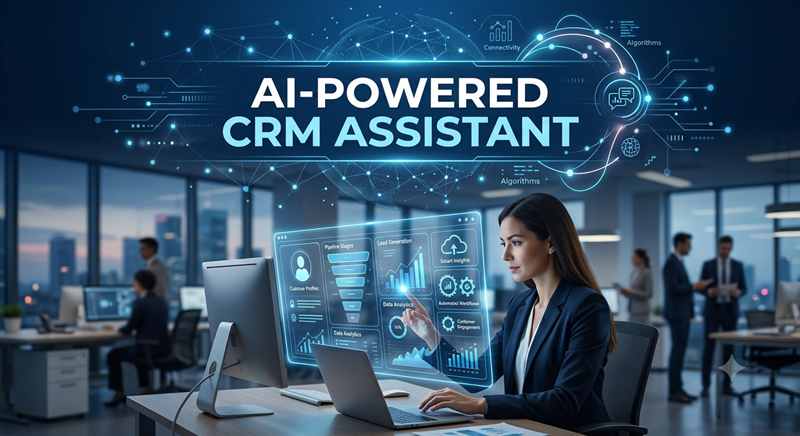
An AI-powered Customer Relationship Management (CRM) assistant combines artificial intelligence, machine learning, automation, and customer data to help businesses manage relationships more effectively. It can automate repetitive tasks, analyze customer interactions, identify sales opportunities, recommend next steps, and provide personalized communication.
Unlike traditional CRM systems that primarily store and organize customer information, AI-powered CRM assistants actively help businesses use that information to make smarter decisions.
From improving lead management to enhancing customer support, AI-powered CRM assistants are changing how organizations connect with their customers. They are becoming an important part of modern business strategies focused on productivity, customer satisfaction, and sustainable growth.
Let’s explore how an AI-powered CRM assistant works, its key features, benefits, and why it represents the future of smarter customer engagement.
- What Is an AI-Powered CRM Assistant?
- How Does an AI-Powered CRM Assistant Work?
- Key Features of an AI-Powered CRM Assistant
- Benefits of Using an AI-Powered CRM Assistant
- Real-World Applications of AI-Powered CRM Assistants
- How AI-Powered CRM Assistants Improve Customer Engagement?
- Challenges of Implementing an AI-Powered CRM Assistant
- Best Practices for Implementing an AI-Powered CRM Assistant
- The Future of AI-Powered CRM Assistants
- Key Metrics to Measure the Success of an AI-Powered CRM Assistant
- Conclusion
What Is an AI-Powered CRM Assistant?
An AI-powered CRM assistant is an intelligent software solution that uses artificial intelligence to simplify and improve customer relationship management activities.
It works alongside a CRM platform to analyze customer data, understand interactions, automate workflows, and provide actionable recommendations.
For example, when a potential customer submits an inquiry through a website, an AI CRM assistant can automatically capture the lead, analyze the inquiry, assign a priority score, recommend a suitable sales representative, and suggest a personalized follow-up message.
Similarly, when an existing customer contacts support, the assistant can retrieve relevant customer information, summarize previous conversations, and help the support representative provide a faster and more relevant response.
The main purpose is not simply to automate CRM tasks. It is to help businesses understand customers better and make every interaction more meaningful.
How Does an AI-Powered CRM Assistant Work?
An AI-powered CRM assistant combines several technologies to process information and support business operations.
Here is how the process generally works:
1. Customer Data Collection
The assistant collects information from different sources, including website forms, emails, phone calls, live chats, social media interactions, and CRM records.
This information creates a more complete picture of each customer’s preferences, requirements, purchase history, and communication patterns.
2. Data Analysis Using AI
AI algorithms analyze the collected information to identify patterns, customer behavior, preferences, and potential opportunities.
For example, the system may recognize that a particular lead has repeatedly visited a product pricing page or requested a product demonstration. This activity can indicate a stronger purchase intention.
3. Intelligent Recommendations
Based on the analysis, the assistant provides useful recommendations to sales and customer support representatives.
These recommendations may include:
- Which leads should receive immediate attention.
- What products or services may interest a customer.
- When to schedule a follow-up.
- Which customers may need additional support.
- How to personalize the next communication.
4. Workflow Automation
The assistant can automate repetitive activities such as data entry, meeting scheduling, lead assignment, follow-up reminders, and conversation summaries.
This reduces manual work and allows employees to focus on activities that require human judgment and relationship-building skills.
5. Continuous Improvement
Many AI-powered CRM solutions use feedback and new interaction data to improve their predictions and recommendations over time.
The quality of these insights depends on data accuracy, model performance, system configuration, and ongoing monitoring.
Key Features of an AI-Powered CRM Assistant
Modern AI CRM assistants offer several capabilities that help businesses improve customer engagement and operational efficiency.
1. Intelligent Lead Management
Managing leads is one of the most important CRM activities. However, identifying high-quality prospects and prioritizing them manually can consume significant time.
An AI-powered CRM assistant can analyze lead information, engagement history, demographics, and behavioral signals to help sales teams identify promising opportunities.
It can also recommend lead priorities and suggest appropriate follow-up actions.
This helps businesses focus their efforts on prospects who are more likely to convert.
2. Automated Customer Communication
Timely communication plays an important role in customer engagement.
AI CRM assistants can help generate personalized emails, follow-up messages, meeting reminders, and responses to common customer inquiries.
For example, if a prospect requests information about a service, the assistant can draft a relevant response using available customer and product information.
Employees can review and approve these messages before sending them, ensuring accuracy and maintaining the right communication style.
3. Personalized Customer Experiences
Customers are more likely to engage with businesses that understand their preferences and requirements.
AI-powered CRM assistants analyze customer profiles, purchase history, previous interactions, and interests to help businesses create personalized experiences.
For example, an online retailer can use CRM insights to recommend relevant products based on a customer’s previous purchases.
Similarly, a service provider can recommend suitable packages based on a customer’s business requirements.
This makes customer interactions more relevant and helps build long-term relationships.
4. AI-Powered Sales Forecasting
Sales forecasting helps businesses plan their resources, set realistic targets, and make informed decisions.
AI-powered CRM assistants can analyze historical sales data, current pipeline activity, conversion patterns, and other relevant indicators to generate sales forecasts.
These insights help managers understand potential revenue trends, identify sales pipeline gaps, and recognize opportunities that need attention.
5. Smart Task and Workflow Automation
Sales and customer support employees often spend considerable time updating records, scheduling meetings, creating reminders, and managing routine administrative activities.
An AI-powered CRM assistant can automate many of these processes.
Common examples include:
- Automatically updating customer records.
- Creating follow-up reminders.
- Assigning leads to relevant sales representatives.
- Scheduling meetings.
- Generating conversation summaries.
- Updating deal stages based on defined workflows.
Automation reduces repetitive work and helps maintain consistent CRM records.
6. AI Chatbots and Virtual Assistance
AI chatbots can interact with website visitors and customers around the clock.
They can answer frequently asked questions, collect contact details, provide basic product information, and guide visitors toward relevant resources.
More advanced AI assistants can also understand conversational context and retrieve information from approved knowledge sources.
When a query requires human attention, the chatbot can transfer the conversation to an appropriate support representative with relevant context.
7. Customer Sentiment Analysis
Understanding how customers feel about a product or service can help businesses improve their customer experience.
AI-powered sentiment analysis can examine text-based feedback, reviews, emails, and support conversations to identify positive, negative, or neutral customer sentiment.
For example, repeated negative feedback about a particular feature may indicate a product issue that requires attention.
Businesses can use these insights to identify customer concerns and improve their products, services, and communication strategies.
Benefits of Using an AI-Powered CRM Assistant
Implementing an AI-powered CRM assistant can create value across sales, marketing, and customer support operations.
1. Improved Productivity
Automating repetitive CRM activities gives employees more time to focus on important business tasks.
Instead of manually entering information or preparing routine follow-up messages, employees can use AI assistance to complete these activities more efficiently.
2. Better Customer Engagement
AI helps businesses understand customer interests, behavior, and communication preferences.
This makes it easier to deliver relevant messages, provide timely responses, and create more personalized customer experiences.
3. Faster Lead Conversion
AI-assisted lead scoring and prioritization help sales representatives identify prospects who may be ready to make a purchasing decision.
By focusing on promising opportunities and following up at the right time, businesses can improve their sales processes.
4. Reduced Operational Workload
Manual CRM management involves several repetitive activities that can slow down business operations.
Automation helps reduce administrative work, minimize repetitive data entry, and streamline everyday workflows.
5. Data-Driven Decision-Making
AI-powered CRM assistants turn large volumes of customer information into useful insights.
Businesses can use these insights to understand customer behavior, evaluate sales performance, identify market opportunities, and make better decisions.
6. Consistent Customer Support
AI assistants can help support representatives access customer history, find relevant information, and respond to common inquiries more quickly.
This improves service consistency and helps businesses provide a smoother support experience.
7. Better Customer Retention
Maintaining existing customer relationships is just as important as acquiring new customers.
AI can help identify changes in customer engagement, repeated support issues, and potential churn indicators.
Businesses can use these signals to reach out proactively, resolve concerns, and strengthen customer relationships.
Real-World Applications of AI-Powered CRM Assistants
AI-powered CRM assistants can support different business functions across multiple industries.
1. E-commerce Businesses
E-commerce companies can use AI CRM assistants to analyze shopping behavior, recommend products, automate order-related communication, and identify customers who may be interested in specific offers.
For example, a customer who frequently purchases skincare products may receive personalized recommendations based on their previous shopping preferences.
2. Real Estate Companies
Real estate businesses handle large numbers of inquiries from potential buyers and tenants.
An AI CRM assistant can capture property inquiries, categorize leads based on budget and location preferences, schedule property visits, and remind agents to follow up.
This helps agents manage prospects more effectively.
3. Banking and Financial Services
Financial institutions can use AI-powered CRM capabilities to understand customer requirements, organize service requests, and provide personalized product recommendations.
However, sensitive financial decisions require appropriate human oversight, security controls, and regulatory compliance.
4. Healthcare Organizations
Healthcare organizations can use CRM automation to manage appointment inquiries, send reminders, organize patient communication, and improve administrative workflows.
AI systems handling healthcare information must follow applicable privacy and data protection requirements.
5. SaaS and Technology Companies
SaaS businesses can use AI CRM assistants to track product inquiries, manage trial users, identify potential upgrades, and support customer onboarding.
For example, an assistant may identify users who frequently explore premium features and recommend that the sales team reach out with relevant product information.
How AI-Powered CRM Assistants Improve Customer Engagement?
Customer engagement is about building meaningful interactions throughout the customer journey. An AI-powered CRM assistant improves this process in several ways.
Personalized communication: It helps businesses tailor messages based on customer preferences, interests, and previous interactions.
Timely follow-ups: It can recommend the right time to reconnect with prospects and existing customers.
Faster responses: It helps employees retrieve customer information and generate relevant responses quickly.
Proactive customer support: It can identify potential issues and engagement changes that may require attention.
Consistent experiences: It helps maintain customer context across different communication channels and interactions.
When these capabilities work together, businesses can move beyond transactional communication and build stronger customer relationships.
Challenges of Implementing an AI-Powered CRM Assistant
Although AI-powered CRM assistants offer significant advantages, businesses should consider certain challenges before implementation.
1. Data Quality
AI systems depend on accurate and relevant data.
Incomplete customer profiles, duplicate records, and outdated information can affect the quality of AI-generated recommendations.
Businesses should regularly clean, organize, and validate their CRM data.
2. Data Privacy and Security
CRM platforms often contain sensitive customer information.
Businesses must implement appropriate access controls, encryption, data protection policies, and security practices.
They should also ensure that their AI tools comply with applicable privacy regulations and organizational policies.
3. Integration With Existing Systems
Some organizations use multiple software applications for marketing, sales, customer support, and communication.
Integrating an AI-powered CRM assistant with these systems can require technical planning and configuration.
Choosing solutions with suitable integration capabilities can simplify implementation.
4. Employee Training and Adoption
Employees may need time to understand how AI-powered CRM tools work.
Businesses should provide practical training and explain how AI recommendations can support everyday tasks.
The objective should be to help employees work more effectively, not make CRM processes unnecessarily complicated.
5. Maintaining Human Oversight
AI-generated responses and recommendations are not always accurate.
Businesses should establish review processes for important customer communications, sensitive decisions, and high-impact activities.
Human involvement remains essential for complex customer concerns and relationship-building.
Best Practices for Implementing an AI-Powered CRM Assistant
To get the most value from an AI-powered CRM assistant, businesses should follow a structured implementation approach.
- Identify business objectives: Define what you want to improve, such as lead conversion, response time, customer retention, or sales productivity.
- Evaluate existing CRM processes: Understand current challenges and identify tasks that can benefit from AI assistance.
- Choose the right solution: Compare AI capabilities, integration options, customization, scalability, security, and pricing.
- Prepare customer data: Remove duplicate records, correct outdated information, and establish consistent data management practices.
- Start with specific workflows: Begin with practical use cases such as lead prioritization, email drafting, or customer conversation summaries.
- Train employees: Help sales, marketing, and support teams understand how to use AI features effectively.
- Monitor performance: Track relevant metrics and evaluate whether AI automation is improving business outcomes.
- Continuously optimize: Use employee feedback and performance data to refine workflows and improve results.
The Future of AI-Powered CRM Assistants
The future of CRM is moving toward more intelligent, connected, and proactive customer relationship management.
As AI technology continues to develop, CRM assistants are expected to become more capable of understanding customer intent, coordinating workflows, and supporting business decisions.
Some important developments include:
1. More Advanced Conversational AI
AI assistants will continue to improve their ability to understand natural language and respond to complex customer questions.
This will make CRM platforms easier to interact with for both employees and customers.
2. Predictive Customer Engagement
AI will increasingly help businesses identify customer needs and potential problems before they become significant issues.
For example, predictive insights may help identify customers who are showing signs of reduced engagement.
3. AI Agents and Autonomous Workflows
AI agents can perform multi-step tasks within defined permissions and business rules.
In CRM environments, this may include researching leads, updating records, preparing follow-up messages, and coordinating workflows.
Businesses will need appropriate approval mechanisms and monitoring to ensure these actions remain accurate and controlled.
4. Deeper Personalization
AI will help businesses combine customer preferences, interaction history, and behavioral insights to create more relevant experiences.
This can improve communication across the entire customer journey.
5. Omnichannel Customer Engagement
Future CRM assistants will increasingly help businesses maintain consistent customer context across email, websites, messaging platforms, phone interactions, and social media.
This will make customer interactions more connected and less fragmented.
Key Metrics to Measure the Success of an AI-Powered CRM Assistant
Implementing AI is not enough. Businesses should measure its impact to understand whether it is delivering meaningful results.
Some important performance indicators include:
- Lead conversion rate: Measures the percentage of leads that become customers.
- Customer response time: Tracks how quickly customer inquiries receive responses.
- Sales cycle length: Measures the time required to convert a lead into a customer.
- Customer retention rate: Evaluates how effectively a business retains existing customers.
- Customer satisfaction score (CSAT): Measures customer satisfaction with products, services, or interactions.
- Task automation rate: Tracks the percentage of eligible CRM activities completed automatically.
- Sales productivity: Measures sales output relative to the time and resources invested.
- Customer churn rate: Tracks the percentage of customers who stop using a product or service.
Monitoring these metrics helps businesses evaluate performance, identify improvement opportunities, and make informed decisions about their AI investments.
Conclusion
An AI-powered CRM assistant is changing the way businesses manage customer relationships. By combining artificial intelligence, automation, and customer data analysis, it helps organizations move from manual CRM management toward smarter and more proactive customer engagement.
From intelligent lead management and personalized communication to sales forecasting and automated customer support, AI-powered CRM assistants offer capabilities that can improve productivity and strengthen customer relationships.
However, successful implementation requires more than simply adopting new technology. Businesses must focus on data quality, security, employee training, and human oversight to achieve meaningful results.
As AI continues to evolve, businesses that use AI-powered CRM assistants strategically will be better positioned to understand customer needs, respond efficiently, and deliver more personalized experiences.