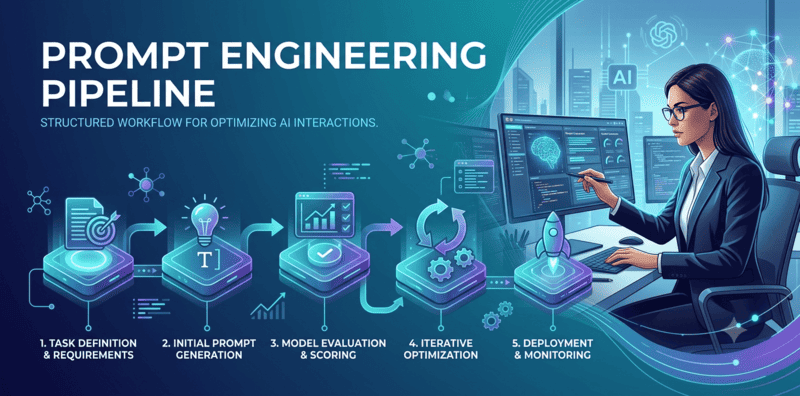
Artificial Intelligence has evolved far beyond simple chatbots. Modern AI applications can research topics, summarize lengthy documents, write code, analyze data, generate reports, answer customer queries, and even automate business workflows. Behind these intelligent systems is an architecture known as a prompt engineering pipeline.
Instead of sending a single prompt to a large language model (LLM), organizations are increasingly building structured pipelines that prepare data, generate optimized prompts, validate responses, and continuously improve output quality. These pipelines make AI applications more reliable, scalable, and suitable for enterprise use.
This guide explains prompt engineering pipelines, their architecture, components, implementation strategies, automation techniques, and best practices for building production-ready AI systems.
- What Is a Prompt Engineering Pipeline?
- Why Prompt Pipelines Matter
- Core Components of a Prompt Engineering Pipeline
- Multi-Step Prompt Generation
- Automatic Prompt Generation Pipeline
- AI Agents in Prompt Pipelines
- Question Answering Pipeline
- Pipeline for Automatic Question Answering
- Self-Improving Prompt Pipelines
- Prompt Chaining
- Reflection Pipeline
- Tree-Based Prompt Pipelines
- Tool-Augmented Pipelines
- Enterprise Prompt Pipeline Architecture
- Popular Frameworks for Building Prompt Pipelines
- Best Practices
- Common Challenges
- Future Trends
- Conclusion
What Is a Prompt Engineering Pipeline?
A prompt engineering pipeline is a sequence of automated steps that prepares information before sending it to an AI model and processes the response afterward.
Rather than relying on one manually written prompt, the system intelligently decides:
- What information is needed
- Which documents should be retrieved
- How the prompt should be written
- Which AI model should answer
- How the output should be verified
- Whether another prompt is needed
Think of it as an AI workflow that improves prompt quality before the model ever sees it.
Instead of:
User → AI → Response
A pipeline becomes:
User Question
↓
Intent Detection
↓
Knowledge Retrieval
↓
Context Selection
↓
Automatic Prompt Generation
↓
LLM Response
↓
Verification
↓
Formatting
↓
Final Answer
This structured approach significantly improves response accuracy while reducing hallucinations and inconsistent outputs.
Why Prompt Pipelines Matter
Large language models are only as good as the information and instructions they receive.
Poor prompts often produce:
- Generic answers
- Incorrect information
- Missing context
- Hallucinations
- Irrelevant responses
Prompt pipelines solve these problems by automating context gathering and prompt optimization.
Benefits include:
- Higher response accuracy
- Consistent outputs
- Lower AI costs
- Faster processing
- Better user experience
- Enterprise-grade reliability
- Easier maintenance
- Continuous improvement
Core Components of a Prompt Engineering Pipeline
1. User Input Layer
Everything begins with a user request.
Example:
“Create a marketing strategy for a SaaS company.”
The pipeline first analyzes what the user actually wants.
Questions include:
- Is it a writing request?
- Is coding required?
- Is external knowledge needed?
- Does the request require calculations?
- Should documents be searched?
2. Intent Detection
Intent classification identifies the task.
Examples include:
- Content writing
- Customer support
- Programming
- Data analysis
- Research
- Translation
- Document summarization
- Financial analysis
Different intents trigger different pipeline paths.
3. Query Optimization
Many users ask incomplete questions.
Example:
Original query:
“Tell me about pipelines.”
Optimized query:
“Explain prompt engineering pipelines for enterprise AI applications with architecture and examples.”
AI can automatically rewrite vague queries into detailed prompts before processing.
4. Knowledge Retrieval
Modern AI systems rarely rely solely on model knowledge.
Instead, they retrieve information from:
- PDFs
- Company documents
- Databases
- Knowledge bases
- APIs
- Websites
- CRM systems
- Product catalogs
- Internal documentation
This architecture is commonly known as Retrieval-Augmented Generation (RAG).
5. Context Selection
Not every document is useful.
The pipeline selects only the most relevant content.
For example:
User asks about pricing.
The system retrieves:
- Pricing documentation
- Product plans
- Discount policies
Instead of retrieving the entire company documentation.
This reduces token usage while improving answer quality.
6. Automatic Prompt Generation
This is where prompt engineering becomes dynamic.
Instead of hardcoding prompts, AI builds prompts automatically.
Example template:
“You are an enterprise AI assistant.
Use only the provided context.
Answer professionally.
If information is unavailable, clearly state that.
Context:
{retrieved_documents}
User Question:
{user_query}”
The placeholders are automatically filled during runtime.
Multi-Step Prompt Generation
Complex tasks often require multiple prompts.
Example:
Prompt 1
Understand the user intent.
↓
Prompt 2
Retrieve supporting documents.
↓
Prompt 3
Generate detailed answer.
↓
Prompt 4
Review for factual consistency.
↓
Prompt 5
Rewrite for readability.
Instead of one large prompt, the system divides work into smaller specialized prompts.
Automatic Prompt Generation Pipeline
One of the newest trends is AI generating prompts for another AI.
Architecture:
User Question
↓
Intent Analysis
↓
Task Planning
↓
Prompt Generator AI
↓
Optimized Prompt
↓
Main LLM
↓
Answer
↓
Evaluation Model
↓
Final Output
Example:
User:
“How can I reduce manufacturing costs?”
Prompt Generator creates:
“You are an operations consultant.
Provide manufacturing cost reduction strategies categorized into procurement, automation, workforce optimization, quality improvement, inventory management, and energy efficiency.
Include practical examples.”
The user never sees this optimized prompt.
AI Agents in Prompt Pipelines
Modern AI systems often use multiple specialized agents.
Example workflow:
Planner Agent
Breaks the task into smaller tasks.
↓
Research Agent
Collects information.
↓
Prompt Agent
Creates optimized prompts.
↓
Answer Agent
Generates responses.
↓
Verification Agent
Checks accuracy.
↓
Formatting Agent
Produces the final output.
Each agent performs one responsibility.
Question Answering Pipeline
Enterprise question-answering systems follow a structured pipeline.
User Question
↓
Language Detection
↓
Intent Classification
↓
Knowledge Search
↓
Document Ranking
↓
Context Selection
↓
Prompt Construction
↓
LLM Answer
↓
Citation Generation
↓
Response Validation
↓
User Response
This architecture powers customer support chatbots, enterprise search, and AI assistants.
Pipeline for Automatic Question Answering
A production-ready pipeline often looks like this:
User Question
      │
      ▼
Preprocessing
      │
      ▼
Intent Detection
      │
      ▼
Knowledge Search
      │
      ▼
Relevant Documents
      │
      ▼
Prompt Builder
      │
      ▼
Large Language Model
      │
      ▼
Fact Verification
      │
      ▼
Answer Formatter
      │
      ▼
Final Response
Each stage can be independently improved without redesigning the entire system.
Self-Improving Prompt Pipelines
Advanced AI applications continuously learn from previous interactions.
Feedback sources include:
- User ratings
- Successful conversations
- Failed responses
- Human corrections
- Response length
- Citation quality
- Accuracy scores
The pipeline updates prompt templates based on performance.
Example:
If short answers receive poor ratings, the system automatically generates more detailed prompts in future interactions.
Prompt Chaining
Prompt chaining connects multiple prompts together.
Example:
Step 1
Summarize uploaded PDF.
↓
Step 2
Extract important statistics.
↓
Step 3
Generate executive summary.
↓
Step 4
Create PowerPoint outline.
↓
Step 5
Generate presentation notes.
Each prompt uses the previous output.
Reflection Pipeline
Reflection improves AI reasoning.
Pipeline:
Generate Answer
↓
Critique Answer
↓
Identify Errors
↓
Rewrite
↓
Produce Final Version
Many state-of-the-art reasoning systems use this architecture.
Tree-Based Prompt Pipelines
Instead of generating one answer, AI creates multiple reasoning paths.
Question
↓
Reasoning Path A
Reasoning Path B
Reasoning Path C
↓
Compare Results
↓
Choose Best Answer
This approach improves accuracy for coding, mathematics, and research tasks.
Tool-Augmented Pipelines
Modern LLMs can use external tools during reasoning.
Examples include:
- Calculator
- SQL database
- Python interpreter
- Search engine
- Weather API
- CRM
- ERP software
- Email services
Workflow:
Question
↓
Need External Tool?
↓
Yes
↓
Run Tool
↓
Collect Results
↓
Build Prompt
↓
Generate Answer
This significantly reduces hallucinations.
Enterprise Prompt Pipeline Architecture
A scalable enterprise architecture typically includes:
User
 │
 ▼
API Gateway
 │
 ▼
Authentication
 │
 ▼
Intent Detection
 │
 ▼
Knowledge Retrieval
 │
 ▼
Prompt Generator
 │
 ▼
Large Language Model
 │
 ▼
Validation Engine
 │
 ▼
Business Rules
 │
 ▼
Response Formatter
 │
 ▼
Analytics
 │
 ▼
User
This design supports security, governance, and performance monitoring.
Popular Frameworks for Building Prompt Pipelines
Several open-source frameworks simplify pipeline development:
- LangChain for chaining prompts, tools, and memory
- LlamaIndex for Retrieval-Augmented Generation (RAG) and document indexing
- Haystack for enterprise search and question-answering systems
- DSPy for programmatically optimizing prompts and AI workflows
- CrewAI for orchestrating multiple AI agents
- AutoGen for multi-agent conversations
- Semantic Kernel for integrating AI into enterprise applications
- LangGraph for stateful AI workflows and agent orchestration
Each framework addresses different stages of the prompt engineering lifecycle.
Best Practices
To build reliable prompt engineering pipelines:
- Use structured prompt templates instead of hardcoded prompts.
- Retrieve only relevant context to reduce token usage.
- Validate responses before presenting them to users.
- Add citations for knowledge-based answers.
- Separate planning, retrieval, generation, and evaluation into distinct pipeline stages.
- Log prompts and responses for debugging and optimization.
- Protect sensitive information with proper access controls and data masking.
- Continuously monitor latency, cost, and answer quality.
Common Challenges
Even well-designed pipelines face challenges such as:
- Hallucinations from insufficient context
- Poor retrieval quality
- Token limitations
- Latency from multi-step workflows
- Prompt injection attacks
- Maintaining context across long conversations
- Balancing accuracy with response speed
- Integrating structured and unstructured data
Addressing these issues requires robust retrieval, validation, and security mechanisms.
Future Trends
Prompt engineering is rapidly evolving toward autonomous AI systems. Emerging trends include:
- Self-optimizing prompt generation
- Agentic AI with autonomous task planning
- Multi-modal pipelines combining text, images, audio, and video
- Memory-aware AI assistants that personalize responses over time
- Real-time retrieval from enterprise knowledge bases
- Automated prompt evaluation using AI judges
- Low-code platforms for building AI workflows
- Domain-specific prompt pipelines for healthcare, finance, legal, and manufacturing
These innovations will make AI systems more adaptive, reliable, and capable of handling increasingly complex business processes.
Conclusion
Prompt engineering has moved beyond writing clever prompts. Modern AI applications rely on structured pipelines that retrieve relevant knowledge, generate optimized prompts, validate outputs, and continuously improve through feedback. By breaking complex tasks into smaller stages and combining techniques such as Retrieval-Augmented Generation (RAG), prompt chaining, AI agents, and automated evaluation, organizations can build AI systems that deliver more accurate, consistent, and trustworthy results.